


If you’ve ever nipped into a dairy and picked up that drink in a glass bottle instead of its evil plastic counterpart, I have some bad news for you.
You see, I’ve spent a lot of time recently reading through life cycle analyses (LCAs) looking at the full impact of various packaging materials.
Welcome to my Ted talk on why glass actually sucks more than you think it does (title is a work in progress).
We talk a lot about plastic. We share the photos and the videos - like the horrendous one we all saw of that poor turtle and the straw which kicked off the plastic straw ban in many parts of the world.
There are headlines about seabird chicks that are so full of plastic that they crunch. There are pictures of rivers clogged with rubbish shown draining straight into our oceans. And yes - that is all true (largely) and all incredibly sad.
But it’s also only part of the story. Because when we focus only on what we can see - usually the end of life, we stop looking upstream at the energy, materials, and systems required to make the other stuff.
End of life is important, but it’s not the full picture, and without that we make bad decisions.
Like buying the glass bottle instead of the plastic one.
First, what is an LCA?
Just briefly, LCAs are reports that assess the full impact of a product from material sourcing through to end of life. They are currently the best tools we have for understanding real environmental impact using real data.
They are how we understand more complex problems - like whether electric vehicles have less impact than cars with internal combustion engines (they absolutely do 99% of the time).
Do they have limitations? Of course. Particularly when it comes to microplastics and long term effects. And that’s because we still don’t actually know that much about them (despite the alarmist headlines). But science doesn’t stay still and tools are being developed as we speak to factor these complexities in.
So they may not be perfect, but LCAs are still vastly better than focusing on one part of a problem and ignoring the rest.
The scale of the problem (Aotearoa edition)
We use 2 billion single-use drinks containers every year in Aotearoa. (What?! For a country of five million people, that is mind-boggling.)
Around ~70% of those containers are made from PET plastic (polyethylene terephthalate).
And every robust LCA I could find came to the same conclusion:
Plastic bottles have a significantly lower overall environmental impact than glass bottles in all single-use scenarios.
Best to worst, the order looks like this:
Recycled PET (rPET)
Virgin PET
Recycled glass
Virgin glass
(I’ll get to aluminium in a min.)
I first talked about this on social media last year and man… the comments. I got called a shill for the oil and gas industry. Which I found hilarious. But sometimes facts get our backs up because they conflict with what we believe. And most of us believe that glass has less impact.
But glass is hugely resource intensive from start to finish.
It requires enormous amounts of energy to manufacture and recycle. It’s extremely heavy, making transport emissions far higher. It has the highest acidification potential (acid rain is still a thing, we just don’t talk about it anymore). It has the highest global warming potential, causes the most eutrophication (nutrient overload in waterways, which leads to algal blooms, which leads to dead zones).
And surprisingly perhaps, it scores the worst for human, aquatic, and terrestrial toxicity. Though I personally reckon that one might change with more information on plastic pollution.
Here’s a graph for you from one of the LCA’s I used.
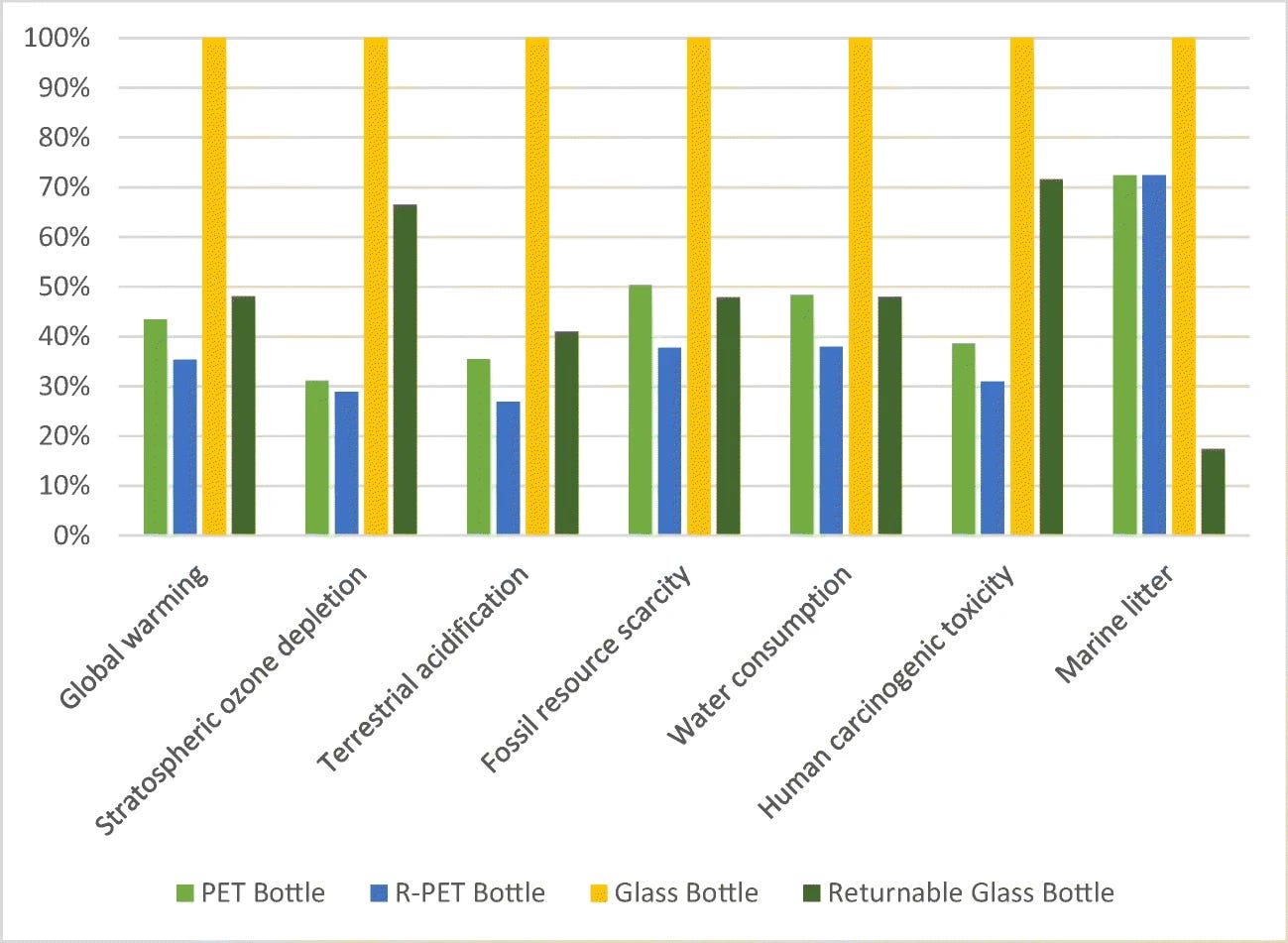
Glass manufacturing has an enormous environmental footprint yet we still treat it as a single-use product and tell ourselves that it’s fine, because ‘it’s just glass! It’s basically just sand’.
And recycled glass is better sure, but not by heaps (energy intensive process) and there ain’t that much of it out there anyway.
Globally, only about 21% of glass is recycled. For bottles specifically it’s closer to 32%.
In Aotearoa, around 42% of collected glass becomes new bottles - mostly in Tāmaki Makaurau Auckland, which is great. But around the rest of the country it’s usually downcycled into roads or paving. So, it’s basically single-use again.
If we looked only at disposal to the environment, glass has less obviously damaging impact.
Glass doesn’t get eaten by animals and it doesn’t break down into microplastics. It doesn’t end up in massive gyres in our oceans, or clog rivers.
That’s the quick and dirty on glass.
If we look at plastic:
Globally, we produce 350 million tonnes of plastic waste every year. JFC.
In 2019:
9% was recycled
20% was incinerated
25% was mismanaged (aka litter)
The rest went to landfill.
Around 0.5% ends up in the ocean - about 2.5 million tonnes annually, although scientists reckon that’s likely to be underestimated.
A quick aside on recycling - there are three big reasons that it was never going to work and the companies pushing it knew that.
The volumes are too large. 350 million tonnes of plastic waste every year - and production is expected to grow another 30% by 2030. There simply isn’t enough infrastructure. It’s also complicated because there are so many different types, with different additives and they don’t all go into one big cauldron.
It doesn’t financially stack up. Recycling plastic is more expensive than making virgin. So why would companies do it?
And finally, a lot of plastic isn’t actually recyclable. It’s down-cyclable. Each time it’s processed it loses some of its properties. That’s why bottles are usually a mix of virgin and recycled.
Oil companies knew this decades ago and spent hundreds of millions convincing us recycling was the solution. Thanks to an investigation by NPR, we know that.
In summary:
You’d have to reuse a glass bottle more than eight times (which is statistically unlikely), to use more resources and emit more pollution per use than a single-use plastic bottle.
And that’s the part that people cannot seem to get past because there are always two arguments when I talk about this.
The first is that the impact of plastic pollution is not considered properly - sure, but apparently it might not move the needle as much as you think it will. And tools are coming, so we’ll soon have a better idea.
The second is ‘but this is a stupid comparison, because the glass bottles get reused’.
No. They don’t.
Glass bottles can be reused loads and loads of times, (though technically so can plastic bottles).
But hardly anyone does that. They are considered single-use just as much as a pump bottle is and after that one drink is finished they end up in the bin.
If we’re going to make the best decisions, we need to look at what actually goes on in the real world. Not the one we wish we lived in.
So where does aluminium fit in?
Aluminium cans have some impressive stats.
About 75% of all aluminium ever made is still in use today.
We use 180 billion aluminium cans globally each year.
Recycling aluminium uses 95% less energy than producing it from virgin ore.
Cans are usually ~70% recycled content.
Global recycling rates sit around 50%, depending heavily on local infrastructure.
So, overall aluminium is your best option.
So it should go:
Can
Plastic bottle
Glass bottle
Except of course it shouldn’t. Because all of this ignores the real problem, which is…
Single-use anything sucks.
None of these options are good.
Single-use anything is an enormous waste of resources. Even when it’s compostable and at least delivers something back in the form of bioavailable nutrients, it’s still such an inefficient system.
Which is why reuse is the real answer.
So… what now?
This whole conversation is a large part of why Incrediballs exists.
When I sold up and left Ethique, I did briefly think about stopping. I thought about retiring, spending more time in the ocean (my favourite place in the world) - and just… not doing another startup.
But this bloody nags at me. Because this problem doesn’t go away. Single-use drinks containers don’t go away. The attitude around single-use is wrong. And once you’ve looked properly at the numbers, and the systems behind them, it’s very hard to just ignore it and move on with your life.
Small changes can shift industries. Ethique helped change the beauty industry - much more to be done of course, but the conversation is a bit different now, and much bigger companies have started to create some interesting product formats. And I don’t think drinks are any different. We don’t need perfect solutions, but we do need to stop pretending that swapping one single-use material for another is better, because clearly, it’s more complicated than that.
Lets do less, reuse more, and design things that don’t rely throwing things in the bin in the first place.
So yes, aluminium generally comes out best, plastic performs better than people expect, and glass is much worse than people think. But the more important point is that none of these are good choices in the first place.
The best option is to get rid of the drinks industry entirely, but remember what I said about operating within the real world? Incrediballs is my solution, rather than pretending people are going to give up everything they enjoy.
Sources (quite a few were behind journal paywalls but these should all be readily accessible).
Brock, A., & Williams, I. D. (2020). Life Cycle Assessment of Beverage Packaging. Detritus, 13, 47–61. https://doi.org/10.31025/2611-4135/2020.14025
Stefanini, R., Borghesi, G., Ronzano, A. et al. Plastic or glass: a new environmental assessment with a marine litter indicator for the comparison of pasteurized milk bottles. Int J Life Cycle Assess 26, 767–784 (2021). https://doi.org/10.1007/s11367-020-01804-x
Tang, Y., Mankaa, R.N. & Traverso, M. An effect factor approach for quantifying the impact of plastic additives on aquatic biota in life cycle assessment. Int J Life Cycle Assess 27, 564–572 (2022). https://doi.org/10.1007/s11367-022-02046-9
Woods JS, Verones F, Jolliet O, Vázquez-Rowe I, Boulay AM (2021) A framework for the assessment of marine litter impacts in life cycle impact assessment. In Ecol Indic 129:p. 107918. https://doi.org/10.1016/j.ecolind.2021.107918
Possibly more user friendly:
https://ecochain.com/blog/case-study-packaging-plastic-vs-glass/
https://environment.govt.nz/what-government-is-doing/areas-of-work/waste/container-return-scheme/
https://www.aluminum.org/Recycling
https://www.bbc.com/future/article/20230427-glass-or-plastic-which-is-better-for-the-environment (always watch what the media says, but it sums up the arguments nicely).
https://international-aluminium.org/
https://ourworldindata.org/plastic-pollution.
Lots of info and reports: https://www.unep.org/resources/publication/addressing-single-use-plastic-products-pollution-using-life-cycle-approach